Monday, April 27, 2020

The Walk to Emmaus as an Examen

Free for anyone reusable masks @ CCRP
Theirs is a crowded loneliness. I call them Max and Cleo. One has a name, Cleopas, the other doesn’t. Some of you know I don’t like nameless characters - so I call the other guy Max. These two, they are getting out of Jerusalem. Followers of Jesus, who days before was put to death as a revolutionary. It was just after the festival, so the road, every road out of Jerusalem would have been crowded. Max and Cleo had every reason to have been scared, but perhaps they were too numb to even feel that. When I see them, I imagine them anxious, confused and bustled on a crowded road. And I find myself with a new reaction to that scene. I shrink back now, try to step aside on their behalf. Trying to care for myself, for my neighbors, There is so much known and unknown A moment of too much and too little. I find myself in the vicinity of Max and Cleo I want to step back, protect them, protect me, and I look around with concern and judginess at the rest of the people and wonder where are your masks?

The location of Emmaus is lost in the sands of time. All the probable locations are at a long foot travel distance which make the told timeline of this tale improbable. Luke is more interested in the meeting the heart than matching the clock. I trust that this episode holds a feeling, an experience a witness of the early days of the risen Jesus. And I know it is the experience of followers in every era who go from huh? to whoa! Emmaus is almost metaphor for whatever space we go to to escape - even if it is in our own mind palace.  Emmaus is that good place we go to get away from all the drama and all the trouble and Jesus meets us there. Where do you go in your heart - where do you desire to go - to get away from the crowded loneliness of now? A space that is verdant but also a blank canvas? Room to find sacred freedom, and to find peace enough to be touched and fed by Jesus? Do you need to carve that out? Even if it is your shower? 

The lesson for the third Sunday, this third Sunday of Easter, It is the outline of how this all fits together - the eternal Christ - born, lived, died, risen, ascended - always present. Do we understand it? No. Do we feel it? Yes. This walk to Emmaus is exploring why Jesus matters in a story format. Max and Cleo on their attempted escape to Emmaus is one of the most central Christian narratives because it tells the complicated drama of what we trust, and how we live, and who Jesus is in our lives. 
The best tool I know of for getting a little bit of “away” so I can focus staying still and getting away to get better at noticing Jesus walking with me is the Ignatian practice of the Examen. And the easiest way to remember it for me is 5 R words. Practiced once a day with these five simple prompts: Relish request review repent resolve. 

Relish is savoring the feelings of the day: what was bitter, sweet, sour, fruitful? Request is the prayer of welcoming God: God who created everything, Jesus who shepherds us, the Spirit that intercedes with sighs to deep for words. Review is considering the agenda of the day with God - what did you do this day? Repent is what do you notice from these savorings and reflection that lead you to confess sin? Resolve is looking forward and setting your intention for a more wholehearted faithfulness tomorrow. 

All 5 of those prompts Relish Request Review Repent Resolve are in the Emmaus story - in another order. Relish - that memory of how their hearts had been burning. Request - inviting Jesus to sit table with them. Review - when they recount the previous days of death and reports of Jesus’ resurrection. Repent - Jesus’ judgement about our foolishness. Resolve - The excitement with which they return to Jerusalem and proclaim what they experienced. That easy examen is a five-word guide to looking prayerfully at the day, which in this time of not knowing what day it is - well, I find it to be priceless. Relish Request Review Repent Resolve. 

We are in the middle of this Corona-tide rumble - it is beyond full of grief and confusion. 50,000 dead from the Covid-19 virus in the US alone. I cannot even wrap my head around the woe of that number. The Spirit sighs too deep for words and Jesus weeps. There is no mistaking that many of us are on a lonely and crowded road - whether we are alone and crowded in by all the news and demands and changes; or if we are dwelling in a crowd and feeling all alone. I see you, I feel you. I am praying with you. 

Easter is here - but the wilderness continues. I am here to encourage you in the name of the risen Jesus - your staying apart, wearing uncomfortable masks, Learning to distance, changing our lists from want to need, the turning over of absolutely everything, for what will be a long while, This is walking with Jesus. It is being the church by taking on his shape, making significant sacrifices for the well being of the last and the least. Our feast with him again will be a while, but that does not distance us from him, does not have to lead us to fail in our sacred duties. 

We are in the middle of this difficult journey - a crowded and lonely rumble with the best and the worst. Max and Cleo, as I call them, were on a similar journey. Today’s lesson is the fullness of the Christian experience, it is the truth of our unique life together-apart right now. For thousands of years this Emmaus journey has been the reality of many followers of Jesus. And in the communion of saints, I trust that they are walking with us too - right now. We are not alone. Christ is with us. The saints are with us. Relish, Request, Review, Repent, Resolve.  

Christ Church, Ridley Park
DioPA
Broadcast on Facebook Live  @christchurchatridleypark 


Monday, April 13, 2020

Easter Like No Other

I make silly poses for the test photos
when I am prepping for a live stream alone.
Before each service these days I worry about my throat giving out. And I remind myself that my favorite singer songwriters stand up on a stage, and sing and chatter for two to three hours. So I repeat at myself: you can do this if they can. But despite current appearances to the contrary, I am not a solo performer. I don’t know how to do this. None of us know how to do this. There is something shadowy and tomb like to stand at an altar with no bread or wine, an ambry with no sacrament, a nave with no hearts or smiles or wiggles.

The disciples and friends of Jesus didn’t know how to do it either. They barely knew what it was to do. The morning light must have been harsh. Were they looking around corners? Hiding their faces? So much they didn’t know. What tumbles in their hearts is probably love and fear and anxiety and trying to ‘just getting on with the living'. That sounds familiar. Suddenly they are interrupted by something like a bold and blazing light, by a startling and world re-doing proclamation: He is not in the tomb. There has never been another Easter like that first one, and there has never been another Easter like this one. Empty church buildings across the world. Not because we quit loving Jesus - but because we love him and follow him. 

He is the heart of this day - and the why of the way that we choose to practice the day of resurrection this year. The center of Easter in Christian practice is not seersucker suits or chocolate rabbits or confetti eggs. The center of Easter is that first utterly world re-creating empty tomb. The blinding light of Easter is the most radical claim of Christian belief and practice - that Jesus who was crucified is not dead but has risen. 

The new creation is glowing and growing, but it also is shedding long shadows. We would be foolish to pretend that anything will ever be normal again. There are vile shadows that are wreaking havoc right now attacking our most vulnerable underbellies and neighbors. The cruel shades of evil won’t be vanquished because someday we will party together again. Such evil needs the masked and gloved disciples of Jesus shining lights of candor and boldly serving for truth. I want to get back to some parts of the life I once knew, I want iced espresso in hip cafes and company. Oh how I want company. Yet at the same time, I feel strangely more connected to you, even at this distance. 

We are called by Jesus in this time on this Easter day to turn, turn from shadows and selfishness rise into courage, pivot into active disciple-d responsibility for ourselves for neighbors, for strangers and for our children’s children. Thank you from the depths of sacred gratitude to everyone on the front lines. Peace be with you who are suffering, suffering the distance, or illness, or because your beloved has died. We are with you, Jesus loves you. We will do our duty because it is how we show that we love God. We are here for you. A new creation comes to life and grows, as Christ’s new body takes on flesh and blood. A universe restored, and all will sing, Alleluia. 

The first thing the believers in the risen Jesus did was not to build church buildings. Church buildings are wonderful and essential and we are quite blessed by this one. Yet the church is a people word. The church is the community of humanity in which Christ Jesus has taken flesh and blood shape. The form of the church isn’t a structure but lifegiving evidence of God in Christ resurrected right now in us. The being of the church is still alive and well and celebrating in different shape and texture. And as long as it aligns with Jesus, as long as it steadfastly practices the promises of baptism, as long as we rise up in empathetic action for strangers, we will never cease to be the church of Jesus Christ. 

Right now we are one with communities of disciples that were the closest in time to the first Easter. We are gathered in homes, proclaiming Christ as Lord, praying, singing, promising, wondering, and serving because God loved us first. We are one together with Jesus Christ because by our distancing, we are acting for all neighbors in concrete ways. This is what we have always meant when we have proclaimed that they will know we are Christians by our love. A new creation is coming to life and growing. 

Resurrection is taking on real flesh and blood in hearts and souls and hands that never thought much about who they are aligned with or what it means to be a practicing Christian. Maybe that is you? If it is, I am glad you are tuning in today. I wonder if Jesus whispering your name beside the empty tomb. We don’t have to know it all, or really know what we are doing, if it is done in the ways of love that are of God. Today we are called to hear Jesus’ voice, chase after God’s commandments, and let the Spirit of the new creation come to life in us together, even while apart. Alleluia. Christ is risen. The Lord is risen indeed. Alleluia! 

(I am playing a bit with the hymn that was sung just before the gospel).

Corona-tide
Christ Church, Ridley Park
Episcopal Diocese of Pennsylvania

Wednesday, February 26, 2020

Holy Boxes - Transfiguration

Maybe for Peter and James and John it was a memory that they couldn’t ever really put words around. Something they didn’t get at the time. Maybe they never really had the sense that they truly got it. Perhaps it was a moment when all the devils they had made deals with were blown away in the light of grace. Maybe it was a moment like absolutely no other, but also at the same time had a taste of something wonderful they had known their whole lives? I don’t pretend to know what happened on that hillside with Jesus that day. I do see that it was precious to these people, to the early church, and it is strange but important to ages and ages of the faithful. 

Even when we look at it with some distance and modern skepticism, we are not standing in a very different place That Peter and James and John not too sure we get what is going on here either, but we know that the tyranny of the ordinary is troubled - and it feels like the kind of sacred mission to which we respond 'I will with God’s help'. Sometimes I enforce a bit of distance from this Transfiguration by laughing at the story. I think - well - 'Bless their hearts'. Setting up a holy carnival is such a Saturday morning cartoon response to this encounter. Then my humor dissolves as I recall that this Gospel account, it isn’t told in the moment, It is told looking backward in time. And then I remember that there have been moments of peace or belonging or revelation in my life that I do wish I could put in a box and keep safe and sound. There were the Easter vigil baptisms where I tell you the Spirit came rushing through the congregation. A goofy spring day with my classmates playing among bluebonnets in the Texas hill country. Moments that loudly and quietly troubled the tyranny of the ordinary.

Jesus has just told the disciples of the path that lay ahead of him, The hard road to the cross that all who follow him must also walk. Their reaction was as to be expected - anxiety, fear, denial, numbskullness. So much of who Peter and James and John became why we recall them as pillars isn’t their perfections, but their frequently mistaken responses to the challenge of Jesus’ love. These guys are exemplars because of how they continued against adversity. May it be that some of the ability to be wrong and still feel beloved, may it have come from the memory and power of that hillside? A moment of endurance and unknowingness all at once. Our memories seem so frail and misled. So of course, they wish they could go back, to the precious power of that day - and to have it always accessible in a tangible container.

Jesus is both so close and so far and sometimes it can feel like our sense of him as our director pales in the light of all the bold demands of life and society. We think we cannot see him through the crowd, our hands are so full that we drop our grip on his hand. What practice or method do you use to hold on to just a glimmer of memory or moment when we did feel close to God when we felt free in the Spirit when we knew the overwhelming loving presence of the One in Three and Three in One? 

Lent begins on Wednesday this Transfiguration is the prelude. It is a bit of a Mardi Gras, a Shrove Tuesday, a pump up the volume of final meaning and festivity and delight before we turn the taps off and put away the silly to look at our messes and terrors and failures with courage and candor. The Transfiguration is the flickering of the lights before the Lenten story, in a foreshadowing of Easter glory. As you think about what your Lent will look and feel like this year I wonder if you could open yourself to let it be a bit deeper this year. Something from our baptismal promises - Continue more earnestly, return more truly, proclaim more daringly, serve more honestly, strive more dutifully? 

Lent began as a time when the whole Christian community walked alongside people who were preparing for the risk and commitment of Christian baptism. Whatever way you choose as a Lenten commitment - let it be one of realism and bravery and discipleship and possibly, uncomfortable transfiguration. If you have been sitting in the parking lot of the Lenten journey, get out of the car. If you have walked the easier path, consider the longer harder one-up the hilll. If you have overdone it, then perhaps find a way to both be holy and not wear yourself out. 

Whatever mystery of love and trampling of the forces of death that happens at Easter it changes everything. And this moment of our lesson today, this Transfiguration, this sacred revelation on the mountain, it is indistinguishable from that holy and lifegiving mystery of Jesus’ resurrection that we will celebrate in 40 days time. So go forth from Jesus’ brilliance on this hillside today, comfortable in the mystery. 

All the perfect ideas of rational thought will never explain what is going on in the Transfiguration or Easter, but such unknowingness does not eliminate their truthfulness. Whatever mystery of love bursts from the tomb on Easter - it is here in this lesson. The shouting down of death and destruction that rises on Easter morning - it is here today - shining out of our belovedness - and it changes everything.

February 23, 2020
Episcopal Diocese of Pennsylvania

Monday, January 6, 2020

Epiphanal Whoa's

It was a morning flight, not too early but maybe early enough that I should have had some coffee before negotiating the security checkpoint. Eventually, I got some coffee, went to my gate. Everybody got on the plane We all sat down buckled our seatbelts, and pretended to listen to the safety instructions. As the plane takes off there is a boy in the back row, and what he says something so loudly that I'd be surprised if the pilot didn't hear him. What he shouted was: Whoa! We are flying! This is the best ride ever!

I don't know about you but I've been flying my whole life I would tell you that airplane travel has ceased to amaze me but I am not sure if it ever did. It has been a fact of life. We have these huge metal contraptions thousands of pounds of steel and plastic and humans and by harnessing the power of science and technology it soars through the skies and moves hundreds of people at a time from Philadelphia to something as far away as London in 7 hours. Before the 20th century, everyone would have wondered what crazy wizardry is this?? But it is now 2020, and I just sit there in this awesome invention and sip my coffee.

The easiest definition of Epiphany and the season after the Epiphany Is the expression: whoa.. Whoa - meaning what that boy on that plane meant energetic, excitement, a good kind of explosiveness. But our season also means the other kind of whoa - the ‘whoa - wait a second’, brought up short kind of whoa. The Epiphan-al season starts with these Magi Looking for Jesus. Often the tradition refers to them as kings they're most likely not kings. That connection starts showing up in the 4th century and it seems to be connected to a our psalm we shared today and a verse of Isaiah, where the rightly royal gifts of frankincense and myrrh are mentioned being brought to a King of Judea. The Magi don’t have names, and they're also not really Wise Guys. That idea picks up steam in the nineteenth century, an era of industrialization, one that celebrated bookish knowledge and where weird phenomena we can't explain is swept under the rug or denied. So this wise guy nick name, it smooths things over: ‘Oh you know they were men of science who found Jesus, no angelic stuff, no stars going the wrong way, no funny business.’ 

The word Magi is probably best translated these days as wizard. Because the courses available at the fictional Hogwarts School of Witchcraft and Wizardry would be quite appropriate to the ancient Magi: astrology, potions, divination. If I was an average woman of Judea in Jesus’s era, I may be a Muggle, but I believe that magic exists and trust that wizards etc are real. Yet, this whole thing, the weird entourage of wizards/magi that comes to find this odd little family of Mary and Joseph and Jesus - it doesn’t seem kosher, I will probably keep my distance. The magi are just as other as the shepherds.

This entire episode is full of mystery and strangeness, and it doesn't match up well with the Lukan version, and it doesn't always mesh well with other historical records. There are a pile of things that invite a mountain of unsureness. Are the Magi connected to the places where gold and frankincense and myrrh are harvested - Africa? Some experts assert the Magi are Zoroastrian - which is still an active religion rooted in modern Iraq and Iran. Other experts say they're definitely diaspora Jewish gnostics. We won’t know because the text doesn’t seem to think this matters. How many Magi - it doesn’t say that either. We tend to fixate on several of the things that the text isn’t concerned about, and perhaps that should give us pause.

I took out a ruler and I measured the birth story in Matthew and this one. The Magi episode is 11 inches of text whereas the baby Jesus episode is only 4 inches (NRSV Oxford Study Bible). In an era when writing materials were precious - this imbalance matters. So if we ignore the accessories we obsess about, hat do we find? Whoa. A frightening and strange moment where the life of Jesus is seriously threatened. Part of what we're supposed to hear in the episode is an echo of the Passion. Secular power gaming with community leaders, evil using hypocrisy and slaughter hold its ground. Our Saviors very life depended on the mercy of strange Magi, who made a long journey, where they found something unexpected, and then daringly defied a dangerous despot, and fled by the risk of a strange route home. The wonderful thing about the inexactness and layers of accessory details Is that they are wonderful tools to help us enter the story. If wise guys with names at the cave helps you connect with the text - then imagine it that way. We learn the sacred kinds of learning through playfulness.  However, when we find ourselves finally in the story, the most prominent question is a hard one: will we go toward Jesus or back to Herod?

For people like us who are encouraged our whole lives to celebrate the technical and the safe and the consumable - of course we focus on the technical and consumable parts. We are also encouraged our whole lives to stifle and distract ourselves from anything that isn't useful or measurable or upstanding - so of course we call them sages or kings rather than magi or wizards. The good news here today is that there is so much we cannot conceive of and even in a reality of so many pitfalls and cruelty, God’s grace and mercy is everpresent, and works through strangers and untrusted sources.

We are not stuck in the spokes of Herod’s manipulations, nor are we alone in a cold clock-like universe. There is more in God’s creation than we will ever imagine, and there is a community of wonderers and seekers and believers that surround Jesus and keep him safe. This same wondrous presence of the Holy Trinity surrounds us too. This Epiphanal season lets have some whoa - excited love and open-eyed questioning. May we never cease to utter whoa whoa whoa in the embrace of the love and mystery and wisdom of God that surrounds us always. And may we know that if we find ourselves in any type of Herod’s web, we can be like the wizards/magi and go home by another way.

January 5, 2020
Christ Church, Ridley Park
Pennsylvania

Monday, December 30, 2019

Word and Word and Word

What is a word? A word is a sound, a speech sound or sounds, that communicate meaning, but can't be divided into little bits of meaningful sound. So for example: mercy. Mercy is a word, whereas mer & Cy are not. Today on the 1st Sunday of the Christmas season, as on Christmas Day, we hear how the Word became flesh and is the person Jesus. The message if we hear it is that Jesus who has been born for us, is the indivisible communication of divine meaning. The Word of God made clear.

What else did we hear about the word of God today? In our psalm we heard that God sends out this word to the creation, and it responds. We heard that this divine word, it moves swiftly. This sacred word can stand up against the cold, and this holy word, it moves as a wind. In the Hebrew, the word for wind is the same word for breath and energy and it is ruach. For us, ruach is the Holy Spirit. This word isn’t text on a page or utterances with no impact. The strange truth uttered this morning is that this word of God is active, from before the beginning began.

Psalm 147 is nearly at the end of the psalter and it is considered to be a part of the closing finale. Behind all its triumphant security is circumstantial evidence of crippling disorientation. This is the celebration of people who have been faced with utter failure, and self-made lostness. Yet what they learned over time and through community discernment is that gruesome reality is not the end of the story. This finale of a Psalm rises into sacred hope and ponders God’s paradoxical endless presence and eternal closeness. It is God who rebuilds who gathers who heals - everywhere. It is God who loves us and calls us by our names - always. It is God who advocate for us, and who lifts up the last and the least - every one of us.

In our translation, the 12th verse of the psalm ends by mentioning God's gracious favor. This is an unusual choice. Other translations choose faithful love or loving kindness or unfailing love orr steadfast love - not a silly sentiment but an active relational promise between God and humanity. The psalms in our prayer book are an unusual work of art. Translating is always a choice and the deciding factor for the prayer book psalms is their chant ability. Furthermore, due to complicated reasons I'll explain some other time, the numbering is a bit different so if you looked up this exact passage of this psalm in most Bible translations you would be looking for verse 11. Anyways, in the word that in our BCP Psalm is verse 12 is gracious favor and elsewhere faithful love: it is In Hebrew one word - hesed. And hesed is one of the 3 Hebrew words That tell the shape and meaning of what We trust are the core characteristics of God. These are mercy, compassion and steadfast love (which in Hebrew is 1 word). Our psalm today only uses one of those Hebrew words, however, the meaning of all 3 words is illustrated in its enchantments. In this vision the one God of the universe created humanity to be in lifegiving community with God and all creation that acts from these bedrock characteristics of God: compassion, mercy, steadfast love.

Then in the Gospel of John, the sacred storyteller opens up with his mind-twisting poetry: Word was God and is God and became flesh Dwelled among us - full of grace and truth. Part of what the sacred storyteller is saying is related to our Psalmic vision - that God's shape and intention is made clear in Christ, this meaning is what is made Human, and while we cannot separate the meaning from Godself, it is also in the same movement made profoundly vulnerable, so to forever transform the dialouge with God’s beloved people.

We have crossed to the other side of the Solstice and from now on this winter the light will grow. The wider world has crossed over from the Winter Wonderland season to the Diet-and-amend-your-ways season. But we here in the church are still in the sacred mystery of Christmas. We are holding dear to us the meaning and intention of all of the words we've spoken and sung through these Advent and Chrismas seasons. Striving to keep the 12 days of Christmas, which are after Christmas: which are right now, striving to keep these as sacred isn't just stubbornness or countercultural. It's letting the newborn word of God breathe in us to shape in us the sacred truth of Christmas, one that is much more than just sweet feelings. Christmas is dialogue between insider and outsider, God and humanity. Conversations that if we hear it make the way of steadfast love - hesed - clear - this child is this clarity. If the last six weeks of study, prayer, and worship didn’t stir in you activity of compassion or steadfast love or mercy, then these last 6 or so days, are a chance to more truly respond to the mystery of Christmas. How will this wonder change you And your conversations, for the better? 

Even now in this time of hatred and division and attacks and atrocities and numbness God's word - God’s meaning and expectation Is made clear, We have a promise to keep and therefore a part to play in this ultimate story. We are called to turn back to the beginning, to be redefined as a part of the sacred mystery of God’s incarnation. As Christmas continues, let us live into God's meaning and God's intention which is summed up in the Word made human: Jesus the Christ: who is mercy, who is loving-kindness, and who is compassion for you and for all. The text does not say that a feeling became flesh. John's gospel says that the Word of God became human. A distinct communication of profound meaning - The Word of God - Was and is this child in Mary’s arms.

December 29, 2019
Christ Church, Ridley Park, PA

Thursday, December 26, 2019

Hold On

As you peer into the cave this night what do you see? Why are you here? What does it mean? As you look into this scene tonight: this isn't a barn no modern stable. It is a gap in the rocks, a cave behind the home of a stranger. The village of Bethlehem is absurdly crowded. This directive from the empire ‘Go to your hometown be counted, but mostly taxed’, it's probably a blessing for this nowheresville; market stands empty; all the rooms rented; extra coins in pockets. Tonight we hear a sacred story we can sing by heart, even the unacquainted. Beyond the ink of the shape of the letters is a white space. It holds the parts of the story, parts the tradition imagines and the parts of the moment that were so every day they weren't worthy of being mentioned.

It's a blip of an ancient town and it is full to the brim. A woman is in the loud process of giving birth. Caring for a woman in labor has almost always been the duty of women. Rest assured, there were unacknowledged women there. And there were other onlookers I imagine. Curious people built for connection and empathy. They heard and they responded. The neighbors who said no when Joseph knocked, but now.... One of the most steadfast rules of righteousness among these people - is hospitality. And you didn't make room, and so in self-judging shame, You go out to find where they landed.

There in that cave, we discover lowlife shepherds Who made it here first. Stinky sheep and grungy people speaking about angels and peace and the redemption of all the world. It is almost morning and you're awake and you're here and you look into this cave - and you wonder: why? This world-changing night it's not glamorous nor cute. It is cold and dirty and guilty while at the same time It is full of love, glowing with redemption declaring a new way for life on Earth. Godly goodness and power is right here in the mess, in the only space it could find In our fractured selfish ways. Here we see that everyday matter can bear God, can welcome God, is one with God. And this child who has been born, this Jesus is born for us - our advocate. What is it he is advocating for? How is he for us?

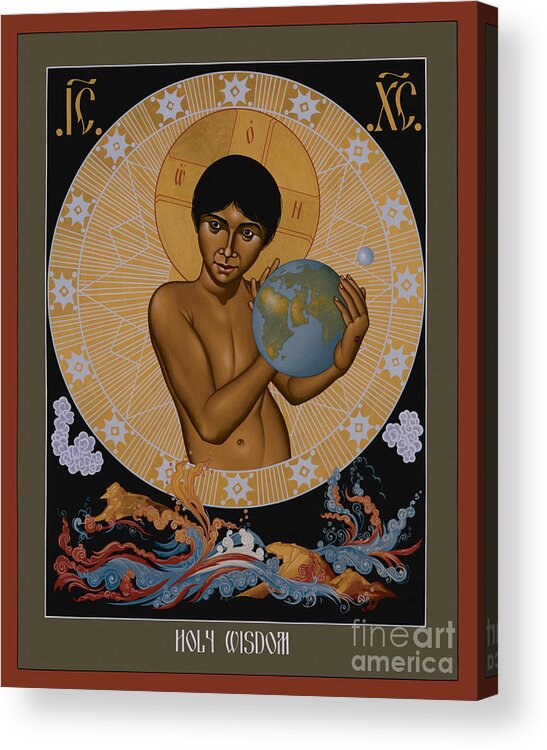
For me, one of the most potent ways to illustrate the mystery of Christmas is to flip the image. To reverse who holds what. Over by our devotional candles, I have placed a print of an icon that usually resides in my office. The title of the icon is Holy Wisdom. Above fiery and watery chaos a young person emerges from the Sun a person who holds the Earth as we would hold a precious child, but also in a posture that is ready to act - a body in motion. We know it is Christ by the iconography of his halo. The print has grown dark over the years but if you were to look close you might see the scars on his hands. To me the mystery of Christmas means just this - it means both: Mary holding Christ in her hands, and just the same, Jesus holding us in his hands. In both our true brokenness is made clear by our inhospitality to all that God so dearly loves. In both our true possibilities and salvation are also made clear by the deep love and hope that the images together declare. Will we hold every bit of creation as tenderly as Mary holds Our Savior and as Christ holds the world?

If you come here tonight because of a tickle in the back of your mind that there is something more than isolation and anxiety, I'm glad you're here and Christ loves you and welcomes to you. If you come here tonight because someone said you had to, I'm glad you're here and God loves you and welcomes you. If you come here tonight not knowing exactly what we are up to, but it is a tradition that sparks joy in you, I'm glad you're here, and wonder what kind of love the spirit of God is stirring up in you. Whatever reason you are here tonight we welcome you as a beloved child of God.

It is dark, but the dawn of Christmas morning has already shone forth across the earth. Tonight we sit and stand and sing in a quite glorious cave with all who do so now, and in the past, and in the future. As we gather around the Christ child, we also see Jesus the adult who said such wonderful things and did such amazing things that people followed him. Tonight as we peer into the cave at a precious scene we should also be struck by its connection to the cave in which his crucified body will be placed. Tonight as we gather around a desperate woman and a dutiful man with the vulnerable newborn and outcast strangers, we should know that this infant is the One who rose from our death-dealing ways and loves us still. As you go out from this shadowy cave this Christmas night, may the way of Jesus Christ fill your path the light, may it slowly grow and reveal his precious new world in us. Merry Christmas!

December 24, 2019
Christmas Eve Later Service
Christ Church, Ridley Park, Pennsylvania

Monday, December 23, 2019

Too Cool to Be Joseph?

It was a beautiful fall day in Albuquerque. still warm enough to sit outside at lunchtime. my friend Molly and I had gotten together for our pretty much weekly lunch meetup. I was already well into Christmas planning mode - and I was complaining a bit. Mary was cast, Jesus was cast, I had talked one teen into being a fire angel in the Christmas Pageant. But finding a Joseph was like finding someone to scrub toilets. As it happens Molly’s son George was with us that day. I don't have any idea why he wasn't in school because he certainly wasn't sick. It is worth mentioning that George had volunteered to be Joseph twice in recent years. So I asked him why do you think other boys don't want to be Joseph in the pageant? 

He replied quickly: Because they didn't want to act like a caring parent, And they probably thought it was weird and icky to have to pretend that they were in love with Mary. They think they're too cool for any of that.' After a bite he continued, 'Which is dumb,  cause Joseph Is awesome. He's all right with not being the most important person. He was a good dad and had a hard task and the whole scary angel in a dream thing - Yeah he did what he was asked and he didn't complain. Joseph is awesome.' 

Our Gospel lesson today is full of weird and discomfort. We have a grown-up story that's only barely edited in translation. A grown up story that we annually invite young people to pantomime. It's also weird and uncomfortable because the reason for turning the moment of rescue comes from the appearance of an angel in a dream. The world in which Jesus was born into was one that expected the extraordinary other to be interfering in our lives connecting to our brains healing our bodies. There's nothing shocking to the ancient hearer about angels and directed dreams. But us today in our rational conventional norms? These things still happen, but in my circle, they are shared only with trusted friends And even then in hushed voices. 

It may surprise you but we don't have a well-developed official angelology, certainly not the Episcopal Church or most Protestant churches. Most of the common depictions are not what we read of in the Bible, many common beliefs are not and have never been Christian teaching - bells and wings for example. Angels in the Bible are carriers of messages so much so that they are the message. The oldest mentions of angels in the Hebrew Scriptures have almost no description at all We are left with an impression Of strange human like visitors. By the era of the last written texts, the description of angels in Ancient Judaism sounded more like Hindu gods with lots of terrifying wings and eyes, and they act rather like greek gods, and they have names and pronouns that are always masculine. No precious moments there.

I trust that God is the creator of all things that God has made a universe that has little bits I can comprehend and a whole lot more that I'll never be able to manage. For me, Angels are mysterious embodiments of God's communications Between what I can understand And the marvelous mysterious everything else. Today an angel appears in a dream, and to me, dreams are in a similar zone. Whatever happens to some people in that stage of dreaming sleep it can be a powerful space of revelation, and an encounter with the glorious and awe-some things that are going on all around us whether we acknowledge it or not. Joseph's story of The experience of an angelic message in a dream connects this scripture to the primordial epics of Jacob and Joseph.

However, much more important to our dwelling in the sacred story is his example. Joseph makes the courageous choice to step into a strange borderland of the revolutionary thing God is doing in the birth of Jesus. Joseph had every social and legal opportunity to wash his hands and walk away. But he didn't. From the point of view of established Christian doctrine it's easy to say of course he stuck around - because this is the birth of God. But in the moment when so much is still not completely clear to him or to Mary or to anyone else… Savior, messiah, liberator - sure these revelations are proclaimed - but the truth of their promise In Jesus the Christ - no one had the full picture for decades.

So let's be honest Joseph’s choice to follow the dream, to trust the angel, to stand by Mary absolutely led to a lifetime in which he was regularly besieged by murmurs both openly and behind his back. His reputation his standing had to have been diminished - because Joseph chose this strange public duty. Christmas is almost here - but lets take a minute to clear away the mess of saccharine trappings for a minute - What would you do in Josephs’s situation? Or if you were his friend? If it is far from the best ways to live, can you bring that deficit to prayer this week?

Bravery isn't always about running into the fire, sometimes it is the measure of our candid embrace with life as it comes to us. Bravery most often bears the everyday tasks of honesty and fidelity and humility. Joseph’s courage is fullfilling his duty and doing so with a mysterious precious promise to hold at the same time. Joseph is a background player, is barely a supporting role. we see him here then as a refugee heading to Egypt, then he's with Jesus and the whole family when Jesus is about 12, and then nothing is said of Joseph again. There are two millenia of traditions and guesses that have grown up around him, but the biblical texts almost seem to forget about Joseph. What my young friend George didn't exactly say but his young words and emotion did say Is that Joseph is an example of allowing oneself to be faithful to an unexpected duty of welcoming the stranger and to do so wholeheartedly, with no reward and almost invisibly. Joseph is awesome. Let’s be awesome - like Joseph was for Christ our Lord. Humility. Service. Fidelity. Compassion. A prime example of what we now call Christian discipleship. May we be just as brave today, tomorrow and for always.
Christ Church, Ridley Park, Pennsylvania
December 22, 2019